

Microsoft’s Ignite 2024 revelations showcase a critical inflection point for business transformation, backed by compelling adoption metrics that should alarm any organization still sitting on the sidelines of AI implementation.
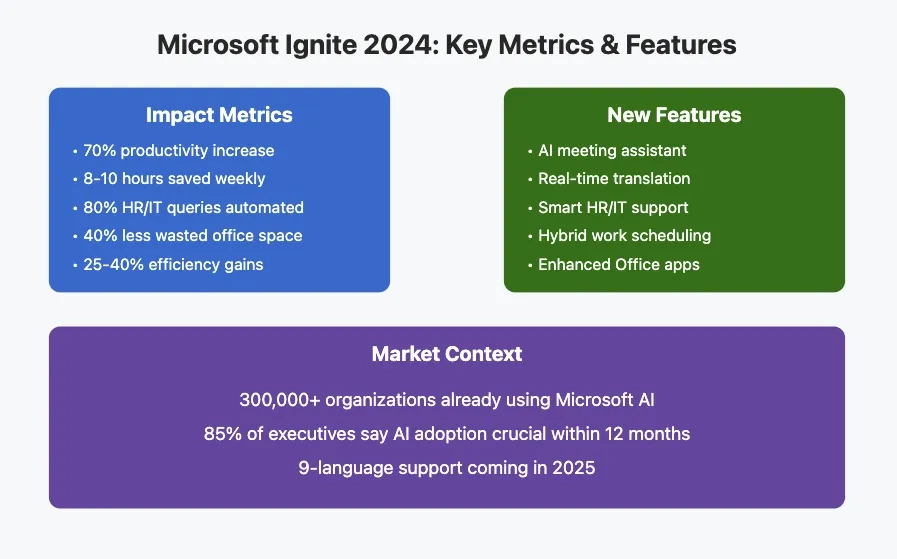
Organizations using Microsoft 365 Copilot report a staggering 70% increase in productivity among early adopters, according to Microsoft’s internal studies. This translates to saving an average of 8-10 hours per week for knowledge workers—nearly eliminating an entire workday of routine tasks.
Microsoft’s new suite of AI assistants is already delivering measurable results. Their meeting assistant automatically captures and summarizes Teams meetings, addressing the estimated 5.5 hours per week employees spend just documenting meeting outcomes. The HR/IT support assistants can handle up to 80% of common employee inquiries without human intervention, dramatically reducing response times from hours to minutes.
For hybrid work management, Microsoft Places’ analytics reveal that uncoordinated office attendance leads to 40% wasted space utilization. Their new intelligent scheduling features promise to boost meaningful in-person collaboration by 65% while reducing real estate costs.
Competitors are moving fast. Over 300,000 organizations worldwide have already integrated Microsoft’s AI tools into their operations. Moreover, 85% of executives surveyed believe companies must adopt AI within the next 12 months to remain competitive.
The company’s productivity suite is receiving transformative AI enhancements. PowerPoint users can now generate entire presentations from simple prompts, while Excel introduces an AI-guided experience for spreadsheet creation. Outlook’s new AI capabilities extend to intelligent meeting scheduling and agenda drafting, addressing common pain points in daily work life. OneNote users will benefit from AI-powered organization features that can transform scattered notes into structured documents.
Recognizing the permanence of hybrid work, Microsoft introduced Places, a comprehensive solution for managing the modern workplace. This tool helps organizations optimize their office spaces by suggesting ideal in-person collaboration days based on team schedules, managing meeting room bookings, and providing detailed occupancy analytics. This data-driven approach aims to make hybrid work more intentional and productive.
For business leaders concerned about measuring returns on technology investments, Microsoft unveiled new analytics tools that track AI adoption rates, productivity improvements, and custom business metrics. These insights help department heads justify their technology investments and identify areas for optimization.
Looking ahead to 2025, Microsoft’s expansion plans include nine-language support for Teams translation and enhanced analytics integration. For IT administrators, natural language system management will reduce routine task time by an estimated 60%.
The business case is clear: early AI adopters are seeing 25–40% efficiency gains across departments. Those waiting to implement these technologies risk falling behind in:
- Employee productivity
- Customer response times
- Operational efficiency
- Talent retention
- Market competitiveness
The message is unambiguous: AI implementation is no longer optional. With Microsoft’s latest tools requiring minimal technical expertise, the barrier to entry has never been lower. The real risk isn’t in adopting AI too early – it’s in adopting it too late.